Scenario · Crew teamwork
A320 Crew scenario
Two at the controls, one team
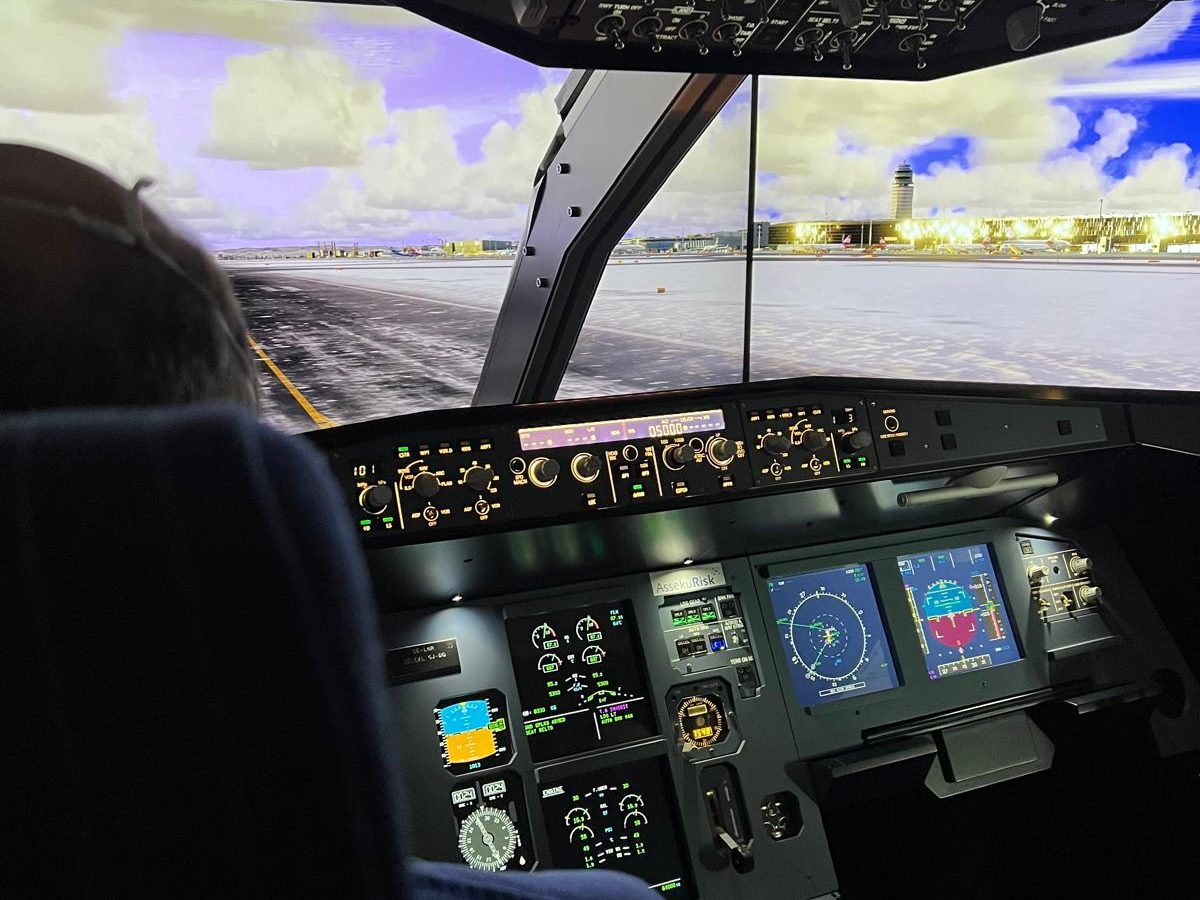
Take your seat in an A320-type flight simulator, set up at your premises. At the controls, a crew of two: one flies, the other monitors. Around them, the rest of the group plays the functions that make a flight happen: air traffic control, cabin manager, operations centre.
From briefing to landing, the crew applies airline methods: checklists, callouts, read-back, cross-checking. Then come the failures and surprises: the crew must share the workload, communicate precisely and decide together.
It is played in small groups, so that everyone takes the controls. Nobody needs to know how to fly: our trainers guide the flight.
Ideal for: teams that work in pairs or small groups — operating theatre and anaesthesia, control rooms, maintenance, operations, response teams.
- ⏱ Half-day or full day
- 👥 Small groups
- All levels
- Crew teamwork
In session
Session timeline
- Arrival Briefing & taking position — objectives, cockpit familiarisation, roles: pilot flying, pilot monitoring, ground and cabin functions.
- Before the flight Preparation — departure briefing, checklists, crew communication rules.
- In flight Failures and surprises — failure, weather, cabin event: callouts, cross-checking, deciding together.
- Rotation New crews — seats rotate: everyone takes the controls and plays the other roles.
- After the flight Debriefing — facts, behaviours, and transfer to your own work situations.
Roles
Pilot flying
Flies the aircraft and announces intentions.
Pilot monitoring
Cross-checks, reads the checklists, dares to say “stop”.
Air traffic control
Issues clearances and sets the pace.
Cabin & operations
Report problems and bring constraints.
Each participant has their own role, information and responsibilities: nobody watches from the sidelines.
🎯
Learning objectives
By the end of the session, participants will be able to:
- run a short briefing that aligns the team before acting;
- use a checklist as a pair, without autopilot or omissions;
- communicate in a closed loop: callout, read-back, confirmation;
- cross-check and dare to flag a deviation;
- decide together after a failure, using a structured method (FOR-DEC).
👁️
What we observe
- Who flies, who monitors: does each keep their role?
- Callouts: made, heard, confirmed?
- Use of checklists under pressure
- Reactions to the other’s error
- Workload: shared or concentrated?
- During the failure: who keeps the big picture?
🔍
Debriefing focus
- Pilot flying and pilot monitoring: two roles, one responsibility
- Checklists and briefings: the value of routines
- Read-back and closed-loop communication
- Tunnel vision, plan continuation and other traps
- Threat and error management (TEM)
Programme sheet
Practical information
Everything you need to organise the session in your organisation.
| Audience | Teams that work in pairs or small groups: operating theatre and anaesthesia, control rooms, maintenance, operations, response teams. |
| Prerequisites | None. The scenarios are designed for non-specialists: everything is explained during the briefing. |
| Objectives | Embed crew methods (briefing, checklists, closed-loop communication, cross-checking) and transfer them to your own work. |
| Duration | Half-day or full day, debriefing included. |
| Group size | Small groups, so that everyone takes the controls. Size agreed with you. |
| Level | All levels. No flying experience needed. |
| Theme | Crew teamwork, CRM, human factors |
| Format | In person, in-house, at your premises or a seminar venue, in France and internationally. We bring all the equipment; you provide tables, chairs, electricity and an internet connection. |
| Teaching methods | Briefing, immersive simulation in which every participant is active, structured four-step debriefing (decompression, facts, analysis, transfer). |
| Assessment | Behavioural observation grid, participant self-assessment, satisfaction questionnaire, formal transfer commitments. |
| Lead time | Agreed with you when you contact us, depending on your dates and our availability. |
| Price | On quotation: it depends on group size, location, duration and number of sessions. |
| Accessibility | Sessions can be adapted for people with disabilities: contact us beforehand so we can plan the necessary adjustments together. |
| Contact | contact@seriousgame.fr — +33 6 75 53 47 69 (WhatsApp) |
What the flight reveals
Tunnel vision, overload, plan continuation: the human traps the debriefing brings to light.
In the cockpit, these behaviours are visible. They are exactly the ones found in your own high-pressure work situations. We observe them during the flight, then analyse them together in the debriefing, without judgement.
🔦
Tunnel vision
Fixated on an alarm or a screen, the crew no longer sees the rest: falling speed, altitude, the controller’s call. Two heads on the same problem, and nobody is flying.
🤖
Over-reliance on automation
The autopilot is handling it, so nobody checks. When it does something unexpected, the crew no longer understands what the aircraft is doing: “What’s it doing?”
➡️
Plan continuation
The crew presses on with the planned approach although the weather or fuel say otherwise. The closer the goal, the harder it is to give up.
🔎
Confirmation bias
Once a diagnosis is made, the crew keeps the clues that confirm it and dismisses those that contradict it.
📶
Authority gradient
Too steep, and the first officer dares not contradict the captain. Too flat, and nobody decides.
🧠
Overload
Alarms, radio and checklist all at once: nobody hears anymore, a step is missed, communication shrinks to single words.
🔔
Interruptions
A radio call in the middle of a checklist: the crew resumes at the wrong place and an item is skipped.
🤐
Things left unsaid
“He must have seen it”, “I won’t say it again”: information known to only one crew member protects nobody.
In healthcare
From the cockpit to the operating theatre.
This scenario is particularly relevant for theatre and anaesthesia teams: healthcare has already borrowed its checklists and CRM (Crew Resource Management) from aviation. The debriefing carries each crew reflex over to a theatre situation: induction, complication, counts, handover to recovery.
−18%
surgical mortality
In US Veterans Affairs hospitals trained in teamwork based on aviation CRM, versus −7% in untrained hospitals (108 hospitals, JAMA, 2010).
1.5% → 0.8%
mortality with the checklist
The WHO surgical checklist, modelled on aviation checklists: complications fell from 11% to 7% in 8 hospitals (NEJM, 2009).
2010
checklist mandatory in theatre
Since 2010, the French National Authority for Health (HAS) has required a surgical safety checklist for hospital certification.
CRM Santé
an HAS module
The HAS PACTE teamwork programme includes a healthcare CRM module: aviation’s Crew Resource Management, adapted to care teams.
What the crew does in flight, the team does in theatre
| In flight (A320) | In the operating theatre |
|---|---|
| Departure and approach briefings | Pre-operative briefing, time-out before incision |
| Normal and emergency checklists | Surgical safety checklist, crisis cognitive aids (cardiac arrest, haemorrhage…) |
| Pilot flying and pilot monitoring | The person operating and those monitoring: cross-checking between surgeon, anaesthetist, nurse anaesthetist and scrub nurse |
| Read-back and closed-loop communication | Verbal orders repeated back, then confirmed |
| “Sterile cockpit” during critical phases | Quiet theatre at induction, emergence and during counts |
| Threat and error management (TEM) | Anticipating patient and procedure risks, catching an error before it causes harm |
| Structured decision-making after a failure (FOR-DEC) | Deciding as a team when an intra-operative complication occurs |
| Tunnel vision on a failure: nobody is flying | Fixation on a complication: nobody is watching the patient as a whole |
| Assertiveness: anyone can say “stop” | The scrub nurse, the junior doctor or the nurse anaesthetist speak up without fear |
| Post-flight debriefing | Post-operative debriefing, morbidity and mortality review |
Sources: Neily et al., JAMA, 2010 (press release) ↗ · Haynes et al., NEJM, 2009 ↗ · HAS surgical checklist (in French) ↗ · HAS — PACTE programme (in French) ↗
Book this scenario for your organisation
We come to you, anywhere, with all the equipment. Let’s talk about your group, your objectives and your dates.